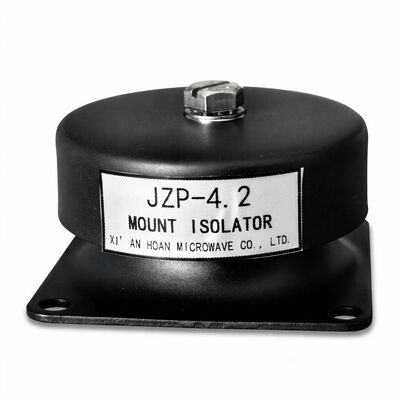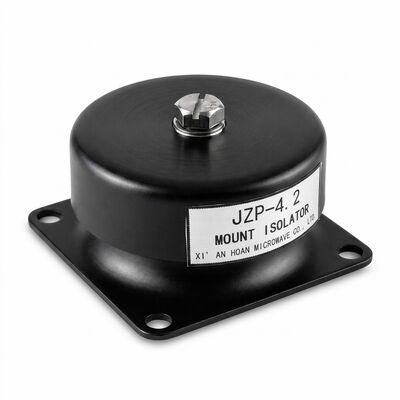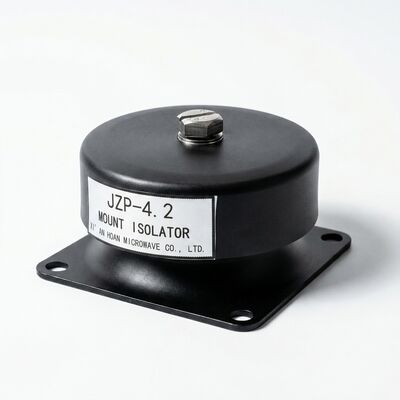
| Brand Name: | Hoan |
| Model Number: | JZP-4.2 |
| MOQ: | 10 Pieces |
| Payment Terms: | L/C,D/A,D/P,T/T,Western Union |
When a Vibration Isolator Mount is subjected to lateral forces — from equipment startup torque, unbalanced rotating masses, or external pushes during maintenance — the rubber element undergoes shear deformation. Poor-quality mounts develop permanent set after repeated shear cycles, causing the isolated equipment to drift from its original alignment. The JZP-4.2 Rubber Vibration Isolator is engineered with a high-recovery elastomer geometry: after 100,000 shear cycles at 80% of maximum rated deflection, residual set measures less than 0.3 mm — well within the 0.5 mm threshold that most precision-aligned pump and compressor sets can tolerate without shimming.
Light machinery is particularly susceptible to lateral displacement because the suspended mass is low relative to the excitation forces. A 35 kg pump package starting under load can generate transient lateral forces exceeding 200 N at the mounting points. The JZP-4.2 Mount Isolator addresses this with a 0.8:1 lateral-to-axial stiffness ratio — meaning lateral movement is only slightly softer than vertical compression, unlike many cylindrical mounts where lateral stiffness can be 3–5* lower than axial. The result: equipment stays centered on its baseplate without needing external snubbers or guides.
| Stiffness Parameter | Value at 20 kg Load |
|---|---|
| Axial Dynamic Stiffness (K_axial) | 145 ±15 N/mm |
| Lateral Dynamic Stiffness (K_lateral) | 118 ±12 N/mm |
| Lateral/Axial Stiffness Ratio | 0.81:1 |
| Shear Modulus (G) | 0.65–0.95 MPa (strain-dependent) |
| Damping Coefficient (C) | 0.55–0.75 N·s/mm at 10–30 Hz |
| Creep Rate at 80% Max Load | < 0.05 mm per 1,000 hours |
Light machinery presents a unique vibration challenge: the equipment mass is low enough that the mounted natural frequency often lands between 8 and 18 Hz — directly overlapping with common motor rotational speeds (1,500 and 3,000 RPM correspond to 25 Hz and 50 Hz excitation). A conventional Shock Absorber Mount with low damping (< 0.05 loss factor) will amplify vibration at resonance rather than suppress it, potentially tripling or quadrupling the transmitted force.
The JZP-4.2 uses a frequency-dependent damping mechanism inherent to its filled-elastomer formulation. At low frequencies (< 15 Hz, including the system resonance band), the damping factor (tan δ) rises to 0.18–0.22, providing effective resonance suppression. At operating frequencies above 25 Hz — where most rotating machinery runs — tan δ drops to 0.08–0.12, delivering efficient isolation (typically 85–92% vibration reduction at 50 Hz).
| Frequency Band | Damping Factor (tan δ) | Isolation Efficiency |
|---|---|---|
| 5–15 Hz (resonance zone) | 0.18–0.22 | Amplification < 2.2* (controlled) |
| 25–50 Hz (operating band) | 0.08–0.12 | 85–92% reduction |
| 50–200 Hz (high-frequency) | 0.06–0.10 | > 95% reduction |
| Parameter | Value |
|---|---|
| Overall Diameter | 40 ±0.5 mm |
| Overall Height (free) | 30 ±0.5 mm |
| Height Under 20 kg Load | 27.5 ±0.3 mm (2.5 mm compression) |
| Stud Thread (top) | M8 * 1.25, length 15 mm |
| Stud Thread (bottom) | M8 * 1.25, length 18 mm |
| Metal Insert Material | Zinc-plated Q235 steel, vulcanized-bonded |
| Rubber-to-Metal Bond Strength | > 3.5 MPa (ASTM D429 Method B) |
| Operating Temperature Range | -25°C to +100°C |
| Installation Torque | 18–22 N·m (use calibrated torque wrench) |
Q: How is shear recovery measured on the production line?
A: Each batch undergoes a 24-hour accelerated creep test: 80% of maximum rated load applied in the lateral direction for 12 hours at 70°C, then released. Residual deformation is measured with a dial gauge at 2 hours post-release. Units exceeding 0.35 mm residual set are rejected.
Q: Does temperature affect the lateral/axial stiffness ratio?
A: Moderately. At -25°C, the ratio shifts to approximately 0.75:1 (slightly softer laterally) due to increased rubber modulus. At +100°C, it softens to about 0.85:1. The ratio remains within the usable range across the entire rated temperature band. No derating is required within the specified limits.
Q: What is the expected service life under continuous 24/7 operation?
A: In a controlled indoor environment (15–35°C, dry, no chemical exposure), the JZP-4.2 is rated for 5–7 years of continuous operation before reaching 1.0 mm of cumulative creep. In outdoor or semi-enclosed installations, expect 3–5 years. Replacement is recommended when total height loss exceeds 2.0 mm (approximately 7% of free height).
Request a detailed dynamic test report, arrange an on-site trial installation, or inquire about bulk order pricing by contacting our technical sales team.