logo

products details

Created with Pixso. Home Created with Pixso. Products Created with Pixso.
Wire Rope Vibration Isolator
Created with Pixso.

JGX-0400D-26A Wire Rope Vibration Isolator Pre-Stressed Uniform Batch Consistency Electrical Grounding EMI Shielding

JGX-0400D-26A Wire Rope Vibration Isolator Pre-Stressed Uniform Batch Consistency Electrical Grounding EMI Shielding

Brand Name: Hoan
Model Number: JGX-0400D-26A
MOQ: 10 Pieces
Payment Terms: L/C,D/A,D/P,T/T,Western Union
Detail Information
Place of Origin:
Shaanxi, China
Certification:
ISO 9001:2015
Model:
JGX-0400D-26A
Material:
Stainless Steel 304
Wire Rope Diameter:
4.0 Mm
Number Of Loops:
8
Load Capacity:
Up To 26 Kg
Natural Frequency:
6-12 Hz
Damping Ratio:
≥15%
Temperature Range:
-40°C To +200°C
Mount Orientation:
Omnidirectional
Finish:
Electropolished
Electrical Conductivity:
Inherent Chassis Grounding Path
EMI/RFI Shielding:
Supports Conductive Gasket Integration
Highlight:

Pre-Stressed Uniform Batch Consistency

,

Electrical Grounding EMI RFI Shielding

,

Thermal Conductivity Zero Heat Aging

Product Description

JGX-0400D-26A Wire Rope Vibration Isolator — Factory Pre-Stressed with Integrated Grounding Path

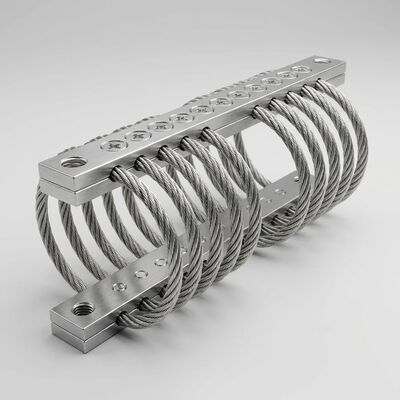
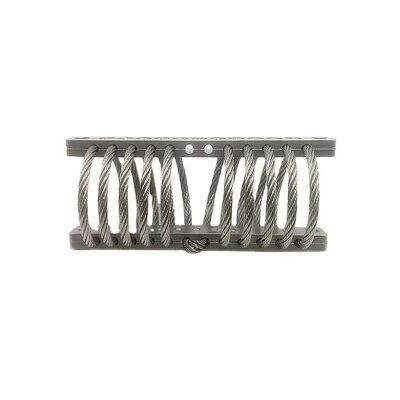
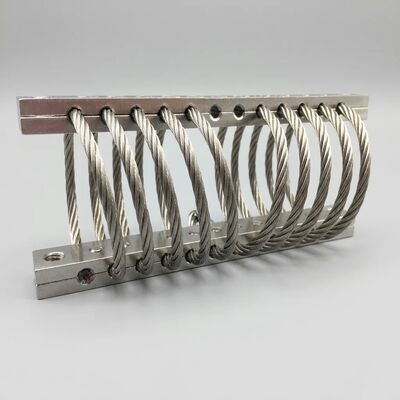
The JGX-0400D-26A is a mid-to-heavy payload wire rope vibration isolator built on a 4.0mm diameter Stainless Steel 304 cable core in an 8-loop symmetric arrangement, factory-rated for up to 26 kg static load per mount. Each loop cross-section contains 133 individual wires in a 7*19 strand configuration, clamped between CNC-machined aluminum alloy bars. The defining characteristic of this model is its 100% factory pre-stressing protocol: every unit is cycled through 100+ load reversals at 150% rated capacity before final inspection, permanently seating the multi-wire cable structure into its stable operating geometry. This eliminates the on-site settling period common to un-calibrated wire rope mounts and guarantees that any two units pulled from separate production batches deliver identical dynamic response. Additionally, the all-metal construction preserves chassis-to-base electrical continuity—a critical consideration for electronic equipment enclosures that must maintain a unified ground reference across vibration-isolated interfaces.

Pre-Stressed Manufacturing & Uniform Batch Consistency

Wire rope isolators rely on inter-strand Coulomb friction for energy dissipation. When newly assembled, individual wires within each 7*19 strand have not yet found their equilibrium seating positions—micro-gaps and uneven contact pressure distributions cause the first several hundred operational cycles to exhibit drifting stiffness and variable damping. The JGX-0400D-26A solves this at the source:

  • Factory Pre-Load Protocol: Each isolator is mounted on a servo-hydraulic test fixture and subjected to a minimum of 100 sinusoidal displacement cycles at ±60% of maximum rated deflection, corresponding to approximately 150% of rated load. This controlled overloading forces every wire strand into its stable tribological contact state—the same state it would eventually reach after weeks of field operation, but achieved in minutes under laboratory control
  • Post-Cycle Dimensional Gate: After pre-stressing, each unit passes through a coordinate measuring inspection where free height, loop symmetry, and mounting bar planarity are verified against master reference values. The acceptance window is ±0.3 mm on all critical dimensions. Units outside tolerance are either re-cycled or scrapped—they never reach inventory
  • Statistical Batch Validation: From every production lot of 100 units, a random sample of 5 isolators undergoes full dynamic characterization on a controlled shaker table. Natural frequency (target 6–12 Hz, load-dependent), damping ratio (minimum 15%), and transmissibility at resonance are measured and recorded. The coefficient of variation across samples is maintained below 3%, enabling equipment designers to specify a single part number with confidence that field performance will be uniform
  • Individual Traceability: Each isolator receives a laser-etched batch code linking to its specific pre-stress cycle data and dimensional inspection record. For customers in regulated industries, this full traceability supports audit requirements and failure analysis protocols

Inherent Electrical Grounding & EMI/RFI Shielding Integration

Electronic equipment packaging presents a persistent conflict: vibration isolation requires mechanical decoupling between the equipment chassis and the mounting structure, but electromagnetic compatibility requires a continuous, low-impedance ground reference between the same two surfaces. Elastomeric isolators create an open circuit that must be bridged with dedicated grounding straps—adding parts, labor, and potential failure modes. The JGX-0400D-26A resolves this through its all-metal architecture:

  • Conductive Mechanical Path: The Stainless Steel 304 wire rope maintains direct metal-to-metal contact with the aluminum clamping bars at both the upper and lower mounting interfaces. While the bulk resistivity of stainless steel (approximately 7.2*10⁻⁷ Ω·m) limits this path's capacity as a primary fault-current conductor, it provides more than adequate continuity to prevent the floating-ground conditions that capacitively couple switching noise into sensitive analog front-ends and ADC input stages
  • EMI Gasket Landing Surface: The flat, machined surface of each clamping bar provides an ideal mounting plane for conductive EMI gaskets—woven wire mesh, finger stock, or conductive elastomer profiles. The gasket compresses between the isolator bar and the enclosure wall, maintaining the Faraday cage continuity that would otherwise be broken by the physical gap across the isolation interface. No separate bonding jumper is required
  • Galvanic Compatibility: The stainless steel-to-aluminum material pair, combined with the electropolished surface finish that removes free iron from the wire surfaces, resists galvanic corrosion in all normal industrial and marine atmospheric conditions. For applications requiring full electrical isolation rather than continuity, the clamping bars can be specified with hard anodizing—contact our applications team to discuss your specific grounding strategy

Thermal Conductivity & Zero Heat Aging

Temperature is the dominant accelerator of polymer degradation. The Arrhenius relationship dictates that every 10°C increase approximately doubles the rate of thermo-oxidative aging in elastomers. In practical terms, a rubber mount rated for 5 years at 25°C may fail in under 6 months at 85°C—a temperature easily reached inside industrial machinery enclosures, solar-exposed outdoor cabinets, and engine-adjacent compartments. The JGX-0400D-26A is structurally incapable of this failure mode:

  • Metallic Thermal Path: Stainless Steel 304 exhibits thermal conductivity of approximately 16 W/m·K. While modest compared to aluminum (205 W/m·K) or copper (401 W/m·K), this is still two orders of magnitude higher than the 0.1–0.3 W/m·K typical of filled rubber compounds. The wire rope core functions as a distributed thermal bridge, conducting heat from the equipment mounting flange into the base structure rather than trapping it at the interface
  • Full-Range Stability: The isolator's rated operating envelope spans -40°C to +200°C continuous without derating. Within this entire range, the dynamic stiffness variation is less than 8%—attributable entirely to the minor temperature dependence of the stainless steel elastic modulus. By comparison, a typical natural rubber compound stiffens by 300–500% when cooled from 25°C to -30°C
  • No Polymer Degradation Pathways: There are no carbon-carbon double bonds to oxidize, no plasticizer molecules to migrate, no cross-link sulfur bridges to rearrange under thermal stress. The chromium oxide passive layer on the stainless steel surface is thermodynamically stable and self-limiting at 2–5 nm thickness. After one decade of continuous operation at 150°C, the isolator's mechanical properties are indistinguishable from its as-manufactured state

JGX-0400D-26A Technical Data

Model JGX-0400D-26A
Wire Rope Construction Stainless Steel 304, 7*19 strand, 4.0 mm overall diameter
Wires per Loop Cross-Section 133 (7 outer strands * 19 wires each)
Loop Configuration 8 loops, CNC-wound symmetric geometry
Clamping Bar Material Aluminum Alloy, machined, laser-marked
Rated Static Load Up to 26 kg per isolator
Natural Frequency Range 6–12 Hz (varies with supported mass)
Nominal Damping Ratio ≥15% (Coulomb friction, frequency-independent)
Peak Shock Damping >25% at high-deflection transient events
Pre-Stress Protocol 100+ cycles at 150% rated load, every unit
Batch CV Target <3% on dynamic stiffness and damping
Temperature Range -40°C to +200°C continuous, no derating
Electrical Path Inherent chassis-to-base continuity via wire rope core

Application Environments

  • Telecommunications base station remote radio units and power distribution
  • Renewable energy inverter cabinets and battery storage enclosures
  • Industrial variable-frequency drive panels and motor control centers
  • Railway signaling equipment houses and platform information displays
  • Marine bridge electronics consoles and navigation processor racks
  • Laboratory analytical instruments and precision measurement systems

WNRLN Engineering Support

WNRLN manufactures the JGX-0400D-26A under ISO 9001:2015 certified quality systems. Every shipment includes batch test summary documentation. Our applications engineering team offers complimentary mounting configuration review—send us your equipment mass, center of gravity coordinates, available mounting points, and vibration environment profile, and we will return a recommended isolator selection with predicted transmissibility curves within two business days. Contact us today to discuss your project requirements or request evaluation samples.