| Brand Name: | Hoan |
| Model Number: | JGX-0958D-108A |
| MOQ: | 10 Pieces |
| Payment Terms: | L/C,D/A,D/P,T/T,Western Union |
Industrial procurement is undergoing a fundamental shift. Environmental compliance, once a box-ticking exercise at the end of a specification process, is now a front-end selection criterion driven by three converging forces: corporate ESG (Environmental, Social, and Governance) reporting mandates, extended producer responsibility (EPR) regulations in the EU and emerging markets, and carbon border adjustment mechanisms that penalize products with high embedded carbon. The humble vibration isolator—a component often selected on unit price alone—carries a hidden environmental cost that accumulates across every replacement cycle over a machine’s 20-year operating life.
The JGX-0958D-108A addresses this at the material level. Its structural simplicity—two materials, two recycling streams—eliminates the end-of-life disposal cost and environmental burden inherent in multi-material elastomeric mounts that bond rubber to steel with vulcanization adhesives, creating a composite that cannot be economically separated for recycling.
Result: Zero kilograms to landfill. Zero hazardous waste classification. Zero disposal cost. Potential scrap metal recovery value of approximately USD 0.30–0.50 per unit at current commodity prices.
A vibration isolator typically represents less than 1% of a machine’s bill of materials cost, but its absence can halt an entire assembly line. This asymmetry—low unit cost, catastrophic shortage impact—makes supply chain resilience the most undervalued attribute in component selection. The JGX-0958D-108A supply chain is architected around three tiers of redundancy to ensure that no single event can interrupt delivery.
A purchasing decision based on unit price comparison alone systematically underestimates the true cost of vibration isolation in industrial equipment. The table below models a 50-isolator installation—a typical count for a medium-sized pump skid, compressor package, or HVAC chiller array—over a 10-year operating life.
| Cost Element | JGX-0958D-108A (Wire Rope) | Elastomeric Mount (NBR) | Notes |
| Unit price (50 pcs) | USD 2,250–4,250 | USD 750–1,500 | Wire rope 3* unit cost of rubber |
| Replacement interval | None (15+ year life) | 3.5 years (avg) | Rubber aging per ISO 11346 Arrhenius projection at 40°C |
| Number of replacements (10 yr) | 0 | 2 | Assuming proactive replacement at 3.5 and 7 years |
| Replacement parts cost | USD 0 | USD 1,500–3,000 | 2 replacements * 50 pcs * unit price |
| Replacement labor (50 pcs * 2 events) | USD 0 | USD 4,000–8,000 | 0.5 hr/pc * USD 80–160/hr technician rate * 100 installations |
| Production downtime (2 events) | USD 0 | USD 2,500–25,000 | 4 hr downtime/event; highly application-dependent |
| End-of-life disposal (50 pcs) | +USD 15–25 (scrap revenue) | USD 150–400 (disposal cost) | Mixed waste handling at USD 3–8/pc |
| Performance drift penalty | None (all-metal, stable) | Progressive (stiffening, loss of damping) | May cause secondary equipment damage from increased vibration transmission |
| 10-Year Total Cost Range | USD 2,235–4,235 | USD 8,900–37,900 | Wire rope delivers 52–89% lifetime cost savings |
Note: Downtime cost is the dominant variable and the most application-specific. The above range assumes a low-to-moderate downtime cost scenario. In continuous-process industries (chemical plants, power generation, semiconductor fabs), downtime costs can exceed USD 10,000/hour, making the economic case for wire rope isolators overwhelming even at a single isolator installation.
| Parameter | Value |
| Model Number | JGX-0958D-108A |
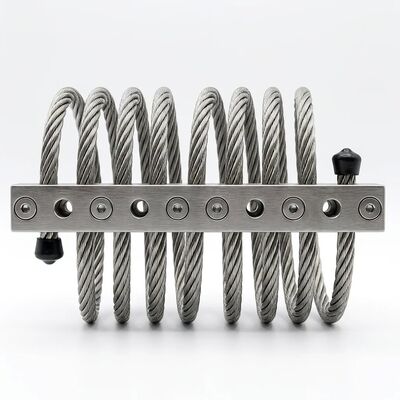
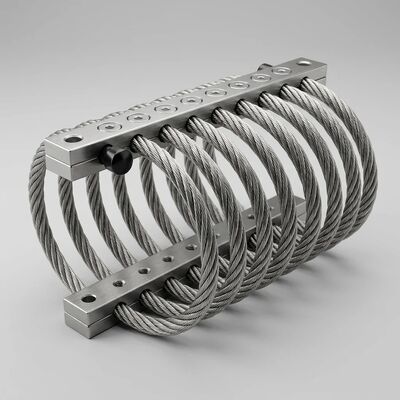
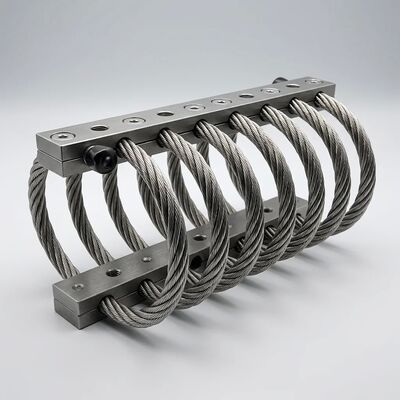
| Isolator Type | Stainless Steel Wire Rope Vibration Isolator, Helical Coil, Dual-Clamp |
| Wire Rope Construction | 7 * 19 (133 individual wires), AISI 304 (UNS S30400) |
| Wire Rope Diameter | 6.4 mm ± 0.15 mm (per ISO 2408) |
| Clamping Block Material | 6061-T6 Aluminum Alloy, hard anodized (25–50 μm, 350–400 HV) |
| Active Coils | 8 loops, symmetric helical winding |
| Rated Load – Compression (Z) | 108 kg (1,059 N) |
| Rated Load – Shear (X/Y) | 54 kg (530 N) per axis |
| Rated Load – Tension (Z) | 36 kg (353 N) |
| Static Deflection at Rated Load | 2.5–3.5 mm (compression), 4.0–5.5 mm (shear) |
| Damping Mechanism | Coulomb (inter-wire dry friction), amplitude-dependent |
| Equivalent Viscous Damping Ratio | 0.15–0.25 (increases with excitation amplitude) |
| Natural Frequency (Rated Load) | 9.5–12.5 Hz (compression), 7.5–10.0 Hz (shear) |
| Resonance Amplification (Q) | ≤4 at resonance (compression mode) |
| Isolation Efficiency at 25 Hz | 65–75% vibration reduction (transmissibility 0.25–0.35) |
| Isolation Efficiency at 50 Hz | 88–92% vibration reduction (transmissibility 0.08–0.12) |
| Shock Attenuation (30 g, 11 ms) | ≥50% peak response reduction |
| Operating Temperature | -40°C to +200°C continuous |
| Endurance Life | ≥1 * 10⁷ cycles at rated load, 10 Hz, ±1.5 mm |
| Mounting Hardware | 4 * M10 * 1.5 mm A2-70 SS bolts, torque 35–40 N·m |
| Mounting Pattern | 120 mm * 80 mm (length * width, center-to-center) |
| Overall Dimensions | 140 mm (L) * 95 mm (W) * 65 mm (H) ± 1.0 mm |
| Unit Mass | 0.85 kg ± 0.03 kg |
| Material Recyclability | 100% (stainless steel + aluminum), zero hazardous constituents |
| Material Certification | EN 10204 3.1 mill test certificates for SS304 wire and 6061-T6 plate |
| Quality Management | ISO 9001:2015 certified |
| Environmental Compliance | RoHS 2011/65/EU, REACH (EC) 1907/2006 |
| Standard Packaging | 20 pieces per export-grade corrugated carton, 25 cartons (500 pieces) per EUR/ISO pallet (1,200 * 800 mm) |
CNC turning centers, 5-axis machining centers, and grinding machines generate broadband vibration from spindle rotation (typically 6,000–20,000 RPM, corresponding to 100–333 Hz fundamental), tool-workpiece interaction, and axis acceleration/deceleration. The JGX-0958D-108A’s 9.5–12.5 Hz natural frequency in compression places the isolation region comfortably below these excitation frequencies, achieving 88–92% vibration reduction at spindle frequencies above 30 Hz. The all-metal construction withstands continuous exposure to water-miscible cutting fluids, way oil mist, and swarf without degradation.
Centrifugal chillers (typically 300–1,500 kW cooling capacity), screw compressors, and cooling tower fan-motor assemblies are the dominant vibration sources in commercial and industrial buildings. The JGX-0958D-108A’s amplitude-dependent damping characteristic is particularly well-suited to HVAC applications: it provides low damping (and thus high isolation efficiency) at the low vibration amplitudes typical of normal steady-state operation, while automatically increasing energy dissipation during the high-amplitude transients of compressor start-up and shut-down.
Reciprocating engines, gas turbine generator sets, centrifugal pump skids, and compressor packages in oil and gas, petrochemical, and power utility applications subject vibration isolators to a harsh combination of continuous broadband excitation, hydrocarbon exposure, and wide ambient temperature swings. The JGX-0958D-108A’s SS304 wire rope resists corrosion from sour gas (H₂S), hydrocarbon condensates, and saline atmospheres in coastal and offshore installations. For the most corrosive environments, an SS316 wire rope option with molybdenum-enhanced pitting resistance is available by special order.
Railcar underframe equipment (brake resistor grids, traction converters, auxiliary power supplies), locomotive engine-generator sets, and heavy commercial vehicle sleeper cab isolation are all applications where vibration isolators must absorb not only steady-state engine vibration but also transient shock inputs from track irregularities, potholes, and coupling impacts. The JGX-0958D-108A’s ≥50% shock attenuation at 30 g / 11 ms half-sine—combined with its all-metal construction that tolerates rain, road salt spray, and stone impact—makes it a direct replacement for elastomeric mounts that harden and crack after 2–3 years of underframe exposure.
What is the minimum order quantity for the JGX-0958D-108A? Evaluation orders start at 10 pieces. For production programs, LTA agreements support scheduled releases with no minimum shipment quantity, enabling just-in-time (JIT) and kanban replenishment models. Standard lead time is 5–7 working days from finished goods inventory, 15–25 working days for production orders exceeding stock levels.
How do I verify the recyclability claim? Material composition certificates (EN 10204 3.1) are available for every production batch, documenting the exact alloy grade of the SS304 wire rope and 6061-T6 aluminum blocks. These certificates can be submitted to your waste management provider or sustainability auditor to confirm that both materials meet the acceptance criteria for standard metal recycling streams. A disassembly instruction sheet with photographic steps is included in every shipment.
What happens to the LTA if metal commodity prices change significantly? The LTA pricing mechanism is designed for transparency and bounded adjustment. Annual price revisions are capped at ±8% regardless of commodity index movement. If LME aluminium doubles and the index calculation would produce a +25% adjustment, the cap holds the increase to +8%—the supplier absorbs the difference. Symmetrically, if commodity prices collapse, the -8% cap protects the supplier from unsustainable price erosion. This structure gives both parties planning certainty while maintaining a link to objective, published price benchmarks.
Can the JGX-0958D-108A be supplied with SS316 wire rope for marine environments? Yes. An SS316 variant (UNS S31600, 2–3% molybdenum content for enhanced chloride pitting resistance) is available with a minimum order quantity of 100 pieces. This configuration is recommended for coastal installations within 5 km of salt water, offshore platforms, and marine vessel engine room applications where the combination of saline atmosphere and elevated temperature accelerates pitting corrosion in standard SS304.