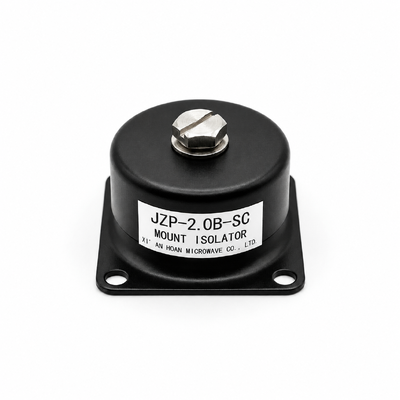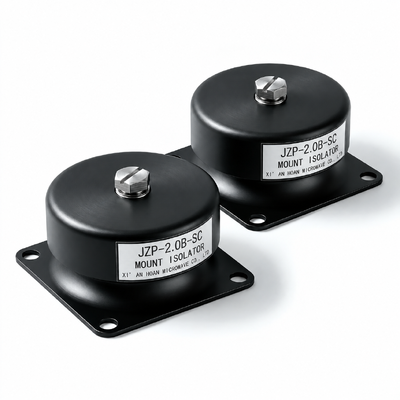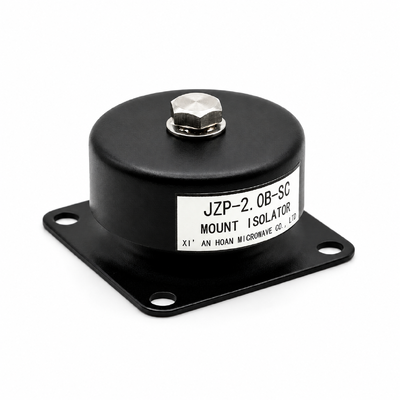
| Brand Name: | Hoan |
| Model Number: | JZP-2.0B-SC |
| MOQ: | 4 Pieces |
| Payment Terms: | T/T,L/C,D/A,D/P |
| Model | JZP-2.0B-SC |
| Type | Rubber shock absorber |
| Rated load | 2.0 kg (±5%) |
| Resonance | 41.5 ±5 Hz |
| Static deflection | ≤0.3 mm |
| Body | Ø46 mm × 30 ±1 mm high |
JZP-2.0B-SC is a 2.0 kg load-class bonded rubber-to-metal shock absorber with a 41.5 Hz resonance frequency and 0.3 mm maximum static deflection. This version of the mount is built for hardware that lives outdoors or under direct sun: the elastomer compound is formulated against ozone attack and ultraviolet exposure, and it is available in a UL94 V-0 rated flame-retardant formulation that self-extinguishes once the ignition source is removed.
The model string is a selection instruction, not a marketing name. JZP identifies the bonded rubber isolator family, 2.0 is the nominal load class in kilograms, and B-SC fixes the body geometry and the mounting arrangement used throughout this page. Buyers who need a different load pick another class from the same family; the body and the interface stay the same, which is what makes the series convenient to design around.
The load class matters more than the appearance of the part. A 2.0 kg mount compressed with 3 kg of equipment sits lower, stiffens, and its resonance moves upward — the isolation band you designed for quietly disappears. Treat 2.0 kg as a design value with a working window of 1.6–2.4 kg, and step up or down a class if your mass falls outside it.
Most rubber mounts are dimensioned for load and then forgotten about the weather. In practice the first thing to fail on an outdoor installation is not the load path but the skin of the elastomer: ozone in coastal and industrial air attacks the strained surface, ultraviolet light breaks the polymer chains, and fine cracks appear at right angles to the stress direction. Once a crack opens, moisture and ozone reach the interior of the section, the crack grows, and the mount fails long before its rated life.
In an enclosed cabinet, a transport interior or any assembly mounted close to battery cells and power electronics, the concern is not whether the rubber burns — most organic elastomers will — but whether it keeps burning after the ignition source is gone and whether it drips flaming material onto what sits below.
Where the installation is a plain indoor machine frame with no ignition risk nearby, the ozone and UV protection alone is usually the reason to pick this variant, and the flame-retardant option can be left out.
| Property | Value | Unit | Tolerance | How the figure is established |
|---|---|---|---|---|
| Nominal load | 2.0 | kg | ±5% | Static vertical load, 23 ±2 °C |
| Static deflection at rated load | ≤0.3 | mm | — | Measured after 30 min settling under 2.0 kg, 23 ±2 °C |
| Resonance frequency | 41.5 | Hz | ±5 Hz | Sine sweep 5–500 Hz, 1 oct/min, 0.5 g axial, 2.0 kg steel test mass |
| Recommended working band | ≥60 | Hz | — | Isolation region, at least 1.4 times the measured resonance |
| Vertical stiffness, calculated | ≈136 | N/mm | — | k = m(2πfn)² with m = 2.0 kg and fn = 41.5 Hz |
| Impact capability | 100 G, 12 shocks | G / count | — | Half-sine 6 ms pulse, axial, 12 consecutive shocks |
| Working temperature | -45 to +65 | °C | — | Continuous operation, no load derating inside the range |
| Service life | 8 | years | — | At rated load, inside rated temperature, ozone and UV exposed surface |
| Elastomer | Rubber, vulcanised to metal | — | — | Black compound, bonded joint verified by static load test |
| Code | Feature | Size | Tolerance |
|---|---|---|---|
| D | Body diameter | 46 mm | — |
| H | Overall height | 30 mm | ±1 mm |
| h | Body height below flange | 21 mm | — |
| A | Anchoring hole pitch | 40 mm | ±0.2 mm |
| B | Base plate width | 50 mm | — |
| d | Top mounting thread | M4 | — |
| d2 | Anchoring hole diameter | Ø5.5 mm | — |
| R | Corner radius | 5 mm | — |
| — | Base plate thickness | 22 mm | — |
Almost every specification error on this type of mount comes from reading one frequency number as if it were the other. The two figures below describe different things, and only one of them tells you what your equipment will experience.
The part is a single vulcanised assembly: an elastomer section bonded directly to its metal inserts during vulcanisation. Bonding rather than clamping means the rubber carries compression and shear through a continuous joint, so repeated shock cannot make the elastomer creep out of its housing, and axial and radial loads do not need separate retention hardware.
Rubber shock absorbers, wire rope isolators, friction dampers and LC filters, produced under an ISO 9001 certified system and shipped to more than 15 export markets.
Give us the equipment mass, the mounting interface and the vibration profile you need to survive, and we will confirm whether JZP-2.0B-SC is the right load class and send the matching test data.
Contact us for a quotation, a drawing or a sample request.