logo

products details

Created with Pixso. Home Created with Pixso. Products Created with Pixso.
Rubber Shock Absorber
Created with Pixso.

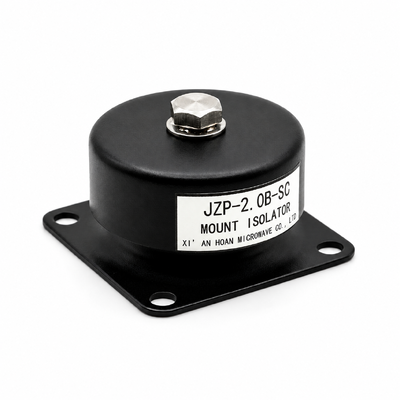
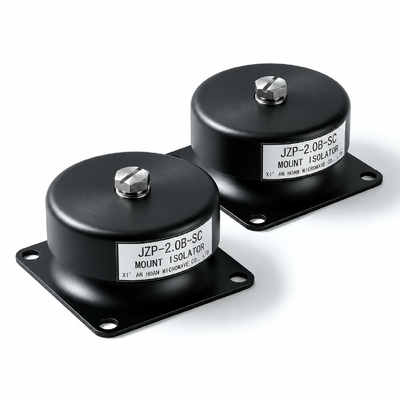
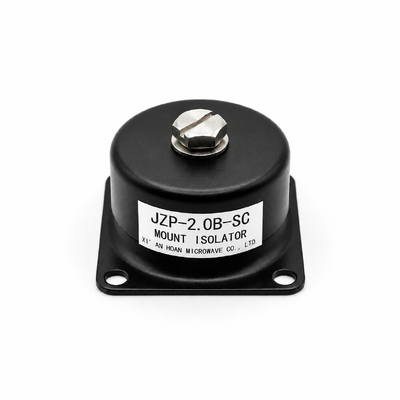
JZP-2.0B-SC Rubber Shock Absorber 30mm Height 100G Impact Rated Mold Resistant Elastomer

JZP-2.0B-SC Rubber Shock Absorber 30mm Height 100G Impact Rated Mold Resistant Elastomer

Brand Name: Hoan
Model Number: JZP-2.0B-SC
MOQ: 4 Pieces
Payment Terms: T/T,L/C,D/A,D/P
Detail Information
Place of Origin:
Xi'an, China
Certification:
ISO 9001:2015
Vertical Stiffness (calculated):
136 N/mm
Service Life:
8 Years
Material:
Rubber & Metal Bonded
Fungus & Mold Resistance:
High-humidity Grade Compound
Strength-to-Weight Ratio:
Optimized For Load-sensitive Systems
Certificate:
ISO 9001:2015
Highlight:

Mold Resistant Elastomer Shock Mount

,

High Strength-to-Weight Ratio Isolator

,

High Humidity Fungus Protection

Product Description
JZP-2.0B-SC
Rubber Shock Absorber · bonded rubber-to-metal vibration isolator, 2.0 kg load class
Part number JZP-2.0B-SC
Category Rubber shock absorber
Load class 2.0 kg
Natural frequency 41.5 ±5 Hz
Envelope Ø46 mm, 30 ±1 mm tall
Static deflection ≤0.3 mm at rated load
Fungus & mould resistantHigh strength-to-weightHumidity stableISO 9001:2015
In one paragraph

JZP-2.0B-SC is a bonded rubber-to-metal shock absorber rated for 2.0 kg, resonant at 41.5 ±5 Hz, 30 mm tall and 46 mm in diameter. This build is aimed at two situations that usually arrive together — plant rooms, tunnels and vehicle undersides where warm humid air lets fungus and mould colonise the elastomer, and lightweight structures such as camera pods and instrument frames where the mass and stiffness of the mount itself must stay small relative to what it protects.

JZP-2.0B-SC Rubber Shock Absorber 30mm Height 100G Impact Rated Mold Resistant Elastomer

Why humid sites destroy ordinary rubber mounts

Humidity is rarely listed as a failure mode, yet it is one of the most reliable ones. An elastomer surface held at high relative humidity and moderate temperature collects dust, condensation and organic debris, and that film is food for mould and fungal growth. The consequences are mechanical, not merely cosmetic.

  • A biological layer holds water against the rubber. The growth keeps the surface wet for far longer than the surrounding air would, which is exactly the condition that hydrolyses the compound and softens the surface.
  • Fungal growth eats the protective skin. Once the surface layer is consumed, moisture reaches the filler and the polymer network, the surface becomes tacky, and dirt binds to it permanently.
  • Stiffness drifts. A softened surface changes the section stiffness, so the resonance you specified at 41.5 Hz no longer describes the part installed in the plant room three years later.
  • The fix is compound-level. JZP-2.0B-SC uses an elastomer protected against fungal growth and mould colonisation, so the surface stays clean and the mechanical values on this page stay valid in laundry areas, cooling tunnels, coastal buildings, food handling spaces and vehicle underbodies.

Mass and stiffness are a budget, not a detail

On a heavy machine frame an isolator can be as bulky as it needs to be. On a gimbal, a camera pod, a portable instrument or a lightweight enclosure, the mount becomes part of the dynamic system it is supposed to protect, and a heavy or over-stiff mount can do more harm than the vibration it was chosen to remove.

  • Load capacity at 2.0 kg in a 46 mm body. The mount carries twice the mass of the smallest class in its family without growing the envelope, so a bracket designed around a small mount does not have to be redesigned.
  • Added mass stays negligible. Because the body is compact, the mount does not pull the assembly resonance down into the excitation band, which is the usual side effect of fitting an oversized isolator to a light structure.
  • Stiffness is a deliberate value. The section is dimensioned so that the axial stiffness giving 41.5 Hz resonance also holds static deflection under 0.3 mm at 2.0 kg, so alignment is preserved on optical and measuring equipment.
  • Bonded joint, not a clamped one. The elastomer is vulcanised onto its inserts, so the joint carries both compression and shear and no retention hardware is needed to keep the rubber in place.

Performance envelope

Item Figure Unit Permissible variation Basis of the figure
Load class 2.0 kg ±5% Static axial load at 23 ±2 °C
Deflection under rated load 0.3 max mm — 30 min settling at 2.0 kg, 23 ±2 °C
Natural frequency 41.5 Hz ±5 Hz Sweep 5–500 Hz, 1 oct/min, 0.5 g, axial, 2.0 kg test mass
Attenuation band 60 and above Hz — Above 1.4 times natural frequency, axial
Stiffness, calculated 136 N/mm — Derived from 2.0 kg and 41.5 Hz, axial
Shock capability 100 G, 12 shocks G / count — 6 ms half-sine, axial, consecutive
Temperature range -45 to +65 °C — Continuous duty, no derating inside range
Design life 8 years — Rated load, rated temperature, humid or outdoor surface
Elastomer system Vulcanised rubber on metal — — Bond integrity checked by static load test

Interface

JZP-B-SC series outline drawing
Dimension Description Nominal Variation
D Body diameter 46 mm —
H Total height 30 mm ±1 mm
h Elastomer body height 21 mm —
A Pitch between anchoring holes 40 mm ±0.2 mm
B Width across base 50 mm —
d Thread at the loaded end M4 —
d2 Through hole for anchors Ø5.5 mm —
R Edge radius 5 mm —
— Base thickness 22 mm —
Measured on unloaded parts at 23 ±2 °C. Flash and parting lines excluded.

 What the curves were produced with

JZP-B-SC series transmissibility curve
  • Running condition: sinusoidal sweep 5–500 Hz, 1 oct/min, axial input; 0.5 mm peak-to-peak displacement held below 20 Hz, 1 g acceleration held above 20 Hz; 23 ±2 °C; 45–75% relative humidity.
  • Fixture (test rig): steel base plate at least 20 mm thick bolted to the shaker table; mount anchored through both Ø5.5 mm holes at 40 mm pitch; 2.0 kg steel block on the M4 thread at 1.2 N·m; accelerometers on the plate and on the block.
  • Applicable boundary: axial compression only. Do not transfer these curves to shear loading, to a different load class, or to a multi-mount installation without re-testing.
JZP-B-SC series shock response curve
  • Running condition: 100 G half-sine, 6 ms, 12 consecutive axial shocks with the 2.0 kg test mass at 23 ±2 °C.
  • Fixture (test rig): the same base plate and anchoring arrangement as the vibration run, input measured on the plate, response measured on the mass.
  • Applicable boundary: 12 shocks at 100 G is the rated envelope for the 8-year life. Beyond that, step up a load class.
The published curves describe the JZP-B-SC family; JZP-2.0B-SC is read at the 2.0 kg load point.