logo

products details

Created with Pixso. Home Created with Pixso. Products Created with Pixso.
Rubber Shock Absorber
Created with Pixso.

JZP-5.0B-SC Rubber Shock Absorber FDA USP Class VI Elastomer 5.0kg Load 41.5Hz Resonance

JZP-5.0B-SC Rubber Shock Absorber FDA USP Class VI Elastomer 5.0kg Load 41.5Hz Resonance

Brand Name: Hoan
Model Number: JZP-5.0B-SC
MOQ: 4 Pieces
Payment Terms: T/T,L/C,D/P,D/A
Detail Information
Place of Origin:
Shaanxi, China
Certification:
ISO 9001:2015
Service Period:
8 Years
Colour:
Black
Hardness:
55 +/- 5 Shore A (ISO 48-4)
Lateral Static Stiffness:
Approx. 470 N/mm
Net Weight:
62 +/- 3 G
Tightening Torque:
2.0-2.5 N.m, Thread Engagement 6 Mm
Mounting Surface Flatness:
0.2 Mm Max
Highlight:

FDA USP Class VI Compliant Elastomer

,

Food Beverage Pharma Line Isolator

,

Laser Etched Batch Code CoC PPAP

Product Description
JZP-5.0B-SC Rubber Shock Absorber Model: JZP-5.0B-SC  |  Type: bonded rubber-to-metal vibration isolator for sanitary food, beverage and pharmaceutical lines
 JZP-5.0B-SC Rubber Shock Absorber FDA USP Class VI Elastomer 5.0kg Load 41.5Hz ResonanceQuick Answer

The JZP-5.0B-SC is a single-piece bonded rubber-to-metal shock absorber rated at 5.0 kg per mounting point, with a vertical natural frequency of 41.5 ±5 Hz, a static deflection of 0.3 mm or less and an envelope of Ø46 mm × 30 mm. It is moulded in an elastomer compound documented to FDA 21 CFR 177.2600 and tested to USP <88> Class VI, and it is laser-etched with a permanent batch code so that the part fitted to a line can be traced back to its cure record, its test report and its certificate of conformity.

Core Parameters
  • Rated vertical load: 5.0 kg (49 N) per mount
  • Static deflection at rated load: ≤0.3 mm
  • Natural frequency, vertical: 41.5 ±5 Hz
  • Recommended working frequency: 10 Hz to 100 Hz
  • Qualification sweep range: 5 Hz to 200 Hz
  • Outside diameter × height: 46 mm × 30 ±1 mm
  • Mounting: M4 thread, tightening torque 2.0-2.5 N·m
  • Operating temperature: -45 °C to +65 °C
  • Net weight: 62 ±3 g
  • Compliance: FDA 21 CFR 177.2600, USP <88> Class VI, ISO 9001:2015 quality system

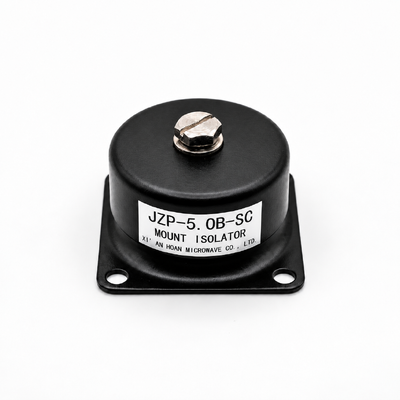
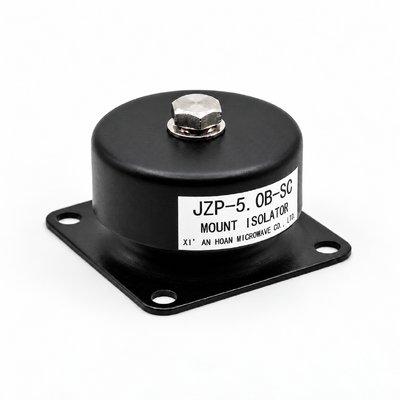
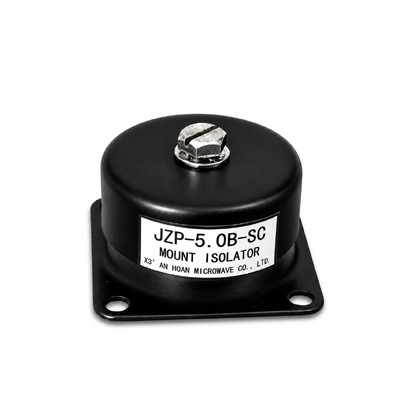
JZP-5.0B-SC as supplied. The black elastomer body carries the laser-etched model, cure date and cavity number; the steel insert is bonded during moulding, so the part has no sliding joint and no separate washer.

What The Part Is And How It Works

Vibration on a filling line or a tablet-press deck arrives in two forms: steady structure-borne hum from pumps, fans and conveyors, and short impact pulses when rams, caps or trays land. A bonded isolator handles both because the same elastomer element carries the static weight in compression and absorbs the dynamic input in shear and compression at the same time. The JZP-5.0B-SC uses a short cylindrical element with a shape factor high enough to keep static deflection inside 0.3 mm at its 5.0 kg rating, which is what puts the vertical natural frequency at 41.5 Hz and the isolation region above roughly 59 Hz.

Three physical numbers drive every application decision. The rated load fixes how many mounts a machine needs. The natural frequency fixes which excitation orders will be amplified and which will be attenuated. The static deflection fixes how much the machine will settle when it is filled, which matters on load-cell platforms and on lines where nozzle height is set once during commissioning. All three are catalogue values for this model, and all three are reproducible on a bench when the fixture conditions described below are respected.

Elastomer Compliance Data

The compound used for this model is a peroxide-cured natural rubber grade without sulfur accelerators, plasticisers of concern or animal-derived content. Documentation is issued per production lot, which means the paperwork a quality department files refers to the exact batch on the pallet rather than to a generic material family.

RequirementReferenceConditionRecorded Result
Repeated-use rubber in contact with foodFDA 21 CFR 177.2600Distilled water reflux, 7 hExtractables ≤20 mg/in²
Repeated-use rubber in contact with foodFDA 21 CFR 177.2600n-Hexane reflux, 7 hExtractables ≤175 mg/in²
Biological reactivity, Class VIUSP <88> in vivo0.9 % saline, 121 °C / 1 hNo reaction observed
Biological reactivity, Class VIUSP <88> in vivo0.9 % saline, 70 °C / 24 hNo reaction observed
Biological reactivity, Class VIUSP <88> in vivo1:20 cottonseed oil, 70 °C / 24 hNo reaction observed
Biological reactivity, Class VIUSP <88> in vivoPEG 400, 70 °C / 24 hNo reaction observed
Food-contact framework and GMPEC 1935/2004, EC 2023/2006Declaration of compliance, lot linkedIssued on request
Restricted substancesRoHS, REACH SVHC listSVHC below 0.1 % by massDeclaration issued
Material declarationsCustomer questionnaireLatex-free, phthalate-free, no animal-derived contentStated on certificate
Mechanical And Physical Properties
PropertyValueUnitToleranceMethod and Condition
Hardness55Shore A±5ISO 48-4, stacked specimen, 23 °C, 1 s reading
Tensile strength≥10MPaMinimum valueISO 37, dumbbell 1, 500 mm/min
Elongation at break≥300%Minimum valueISO 37, dumbbell 1, 500 mm/min
Tear strength≥25kN/mMinimum valueISO 34-1, trouser specimen
Compression set≤25%Maximum valueASTM D395 Method B, 70 h at 70 °C, 25 % deflection
Heat ageing±5 / -15Shore A / %Hardness change / tensile changeISO 188, 70 h at 70 °C
Ozone resistanceNo cracking-Pass or failISO 1431-1, 50 pphm, 40 °C, 20 % strain, 72 h
Rubber-to-metal bond strength≥6kN/mMinimum valueISO 813 peel, 90° configuration, moulded witness specimen
Compound density1.15g/cm³±0.05Hydrostatic weighing, cured slab
Dynamic to static stiffness ratio1.2-Typical valueISO 10846-2, 10 Hz, 0.1 mm amplitude, preloaded to rated load
Vertical static stiffnessapprox. 340N/mmReference valueSecant stiffness, 0-5.0 kg branch, 23 °C
Lateral static stiffnessapprox. 470N/mmReference valueShear loading through base, 23 °C
Damping ratio, vertical0.05-Typical valueHalf-power bandwidth of measured transmissibility curve
Impact resistance100g, 12 shocksNo rupture, set ≤0.1 mmIEC 60068-2-27, half-sine, three axes, 12 pulses per axis
Service period8yearsFrom cure dateArrhenius evaluation of compression set retention
Applications

The model is used on filling and capping carriages, label applicator frames, conveyor drive stations, granulator and tablet-press enclosures, weigh platforms that must be shielded from pump vibration, chiller and air-handling feet inside hygienic rooms, and instrument benches placed next to process equipment. It also suits small skids and dosing cabinets where a level working plane and a clean, wipeable exterior are both required.